Applied Food Research, Vol. 6, 2026 ACM SCF 2026 · Demo

TastePrint: A 3D Food Printing System for Layer-wise Taste Distribution via Airbrushed Liquid Seasoning

Yamato Miyatake,  Parinya Punpongsanon
Saitama University, Japan
TL;DR Instead of preparing one food ink per taste, TastePrint prints a single base ink and airbrushes liquid seasonings onto each layer as it prints. Six solenoid-driven airbrushes and a layer-wise design GUI let you place sweet, salty, sour, bitter and umami where you want them inside the food. Seasoning amount is highly predictable from spray duration (R² = 0.99), spot size is predictable from distance and duration (R² = 0.86), and tasters picked the concentrated pattern as more localized in 27 of 40 trials.
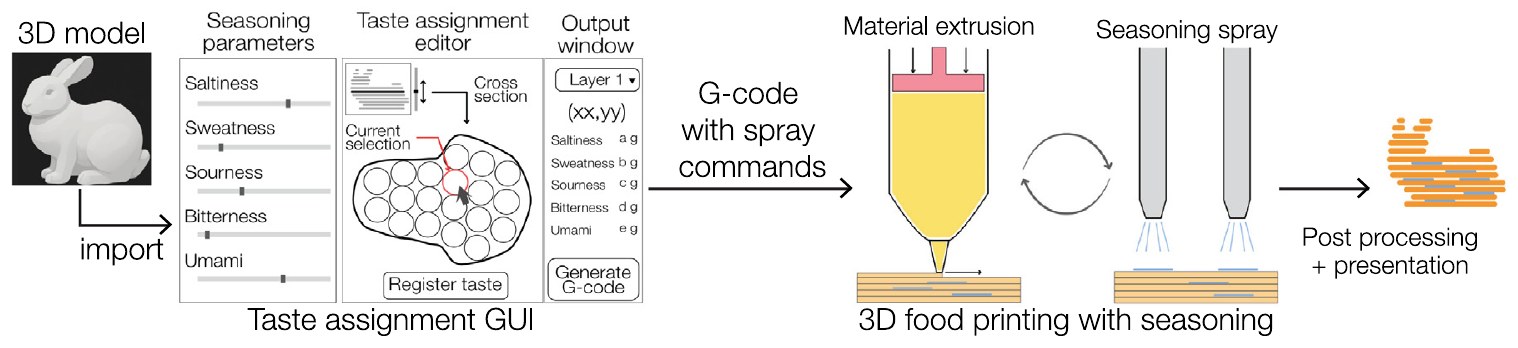
Overview of TastePrint: a taste assignment GUI exports G-code with spray commands to a 3D food printer that alternates material extrusion and seasoning spray.
Overview of TastePrint. Users import a 3D model, slice it, and assign taste distributions per layer in the GUI. The printer then alternates between extruding the base food and spraying liquid seasonings, and the printed food can be eaten directly or post-processed (e.g., baked or fried).

Abstract

3D food printing enables the customization of food shapes and textures, but typically produces uniform taste profiles due to the limited diversity of printable materials. We present TastePrint, a 3D food printing system that achieves layer-wise spatial taste distribution by dynamically applying liquid seasonings with a programmable airbrush during fabrication. The system integrates (1) a graphical user interface (GUI) that allows users to import 3D models, slice them into layers, and specify seasoning channels, spray positions, and intensities, and (2) a customized 3D food printer equipped with a multi-nozzle spray mechanism.

We evaluated the system through technical experiments quantifying spray resolution and deposition accuracy, a minimal sensory discrimination study on taste localization, and an exploratory formative user-feedback study involving three home cooks. The spray-resolution model achieved R² = 0.86, and the spray-amount model achieved R² = 0.99. The filter-paper calibration showed broad consistency with measurements obtained on edible mashed-potato samples. In the sensory discrimination study, participants identified the centralized seasoning pattern as more localized in 27 of 40 trials (67.5%). These findings indicate that TastePrint can provide repeatable hardware-level control over seasoning placement and quantity while offering initial evidence that spatial taste arrangement can remain perceptually meaningful after fabrication.
Video

System

Print the shape once, then season it layer by layer

Multi-material food printers create taste variation by loading a separate ink for each flavour, so taste complexity is capped by the number of print heads, and every recipe change means preparing new inks. TastePrint separates geometry formation from taste modulation: a syringe extruder prints a single base material, and airbrushes mounted around the nozzle deposit liquid seasonings at programmed positions after each layer.

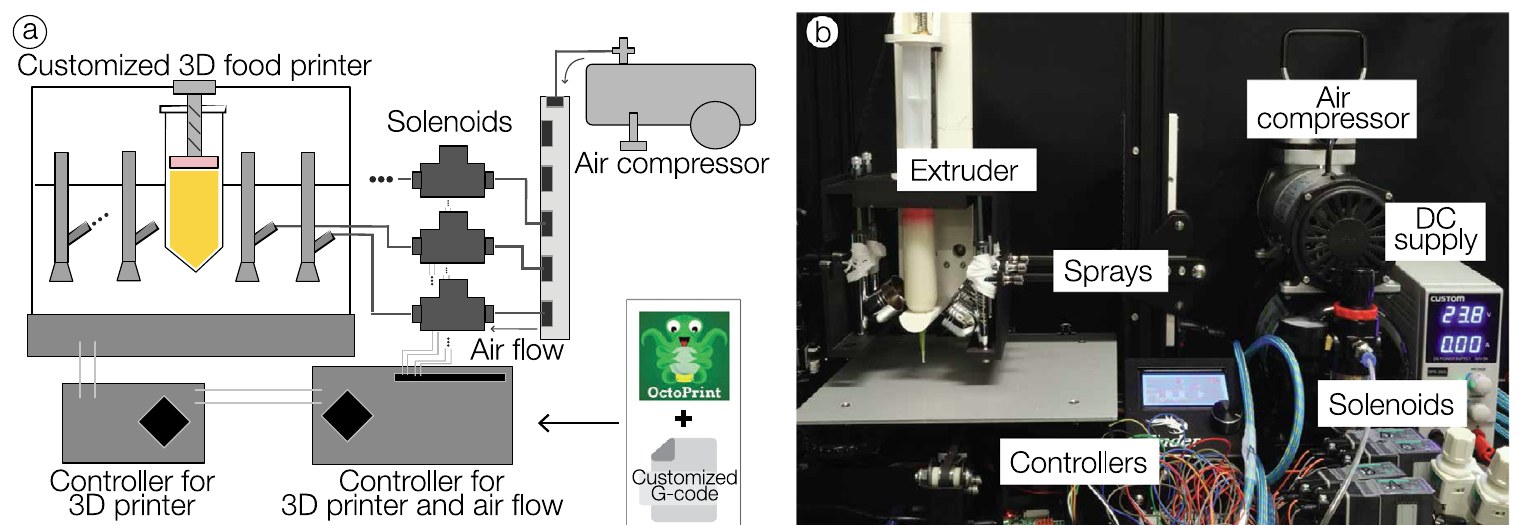
(a) Schematic of the customized 3D food printer with solenoids, air compressor, and controllers. (b) Photograph of the setup with extruder, sprays, solenoids, air compressor, DC supply and controllers.
Spray-integrated 3D food printer. (a) Solenoid valves, driven by a DC supply and switched through custom G-code via OctoPrint, gate pressurized air from a compressor to the airbrushes in sync with the printer controller. (b) The physical setup.
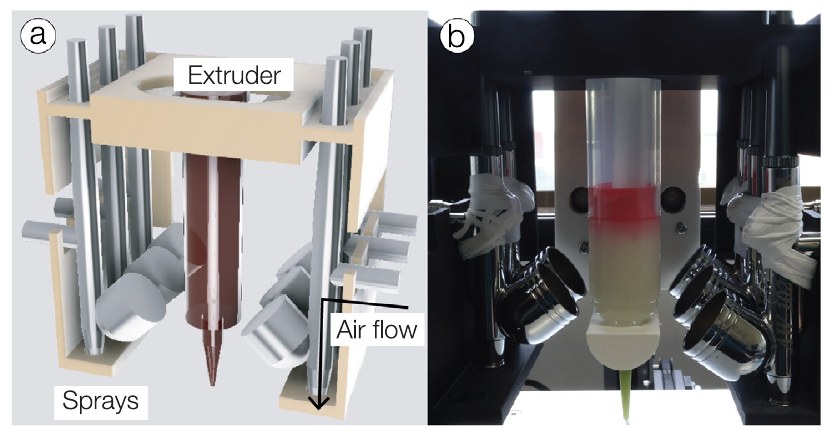
(a) Schematic of the printer head with one material extruder and six spray holders. (b) Fabricated printer head.
Printer head. (a) One material extruder surrounded by six spray holders. (b) The fabricated head on the printer.

Hardware at a glance

Base printer
Creality Ender 3, custom Marlin firmware with extended G-code for airbrush activation
Extruder
30 mL syringe, 1.6 mm nozzle
Seasoning
6 × AW-102 airbrushes (0.2 mm nozzle), CKD solenoid valves, 0.10 MPa line pressure
Control
Raspberry Pi 4 + OctoPrint; 24 V DC supply; GPIO-switched valves

Materials

Base food
Mashed potato paste (water : flakes = 4 : 1), 1.6 mm layers
Five basic tastes
Sweet · sucrose Salty · NaCl Sour · citric acid Bitter · caffeine Umami · MSG
Sixth channel reserved for extensions.
Spray stabilizer
0.5 wt% xanthan gum stops nozzle dripping and gives uniform atomization (0.7 wt% clogged)

Taste Design

Click where the taste should go, layer by layer

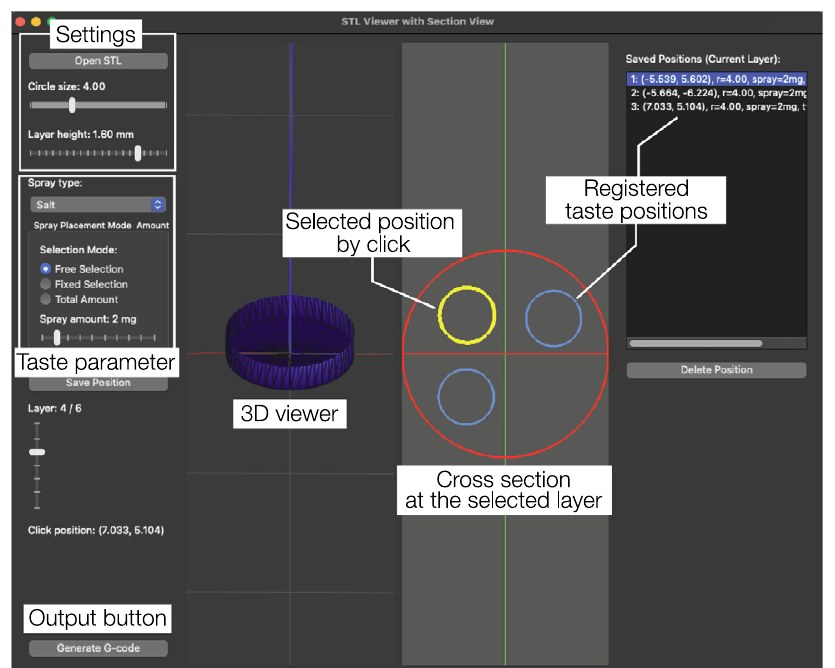
The TastePrint GUI: settings panel, taste parameters, 3D viewer, cross-section at the selected layer with registered taste positions, and output button.
Spray-position editor. Settings and taste parameters on the left; the 3D model and the cross-section of the selected layer in the centre, where clicks register taste positions; registered positions listed on the right.

The GUI (Python 3.11, PyQt5) imports an STL/OBJ model, slices it with the chosen layer height and nozzle diameter, and lets users assign seasoning channels, spray positions and intensities per layer. It then exports one G-code file that interleaves extrusion and spray commands.

Free selection

Manually pick spray positions and intensities for each layer. Gives full control, e.g. for chefs.

Patterned selection

Predefined spatial templates (e.g., dense packing) for quick pattern generation.

Total amount

Specify the total amount of each taste; the system allocates it across layers from the geometry and constraints.

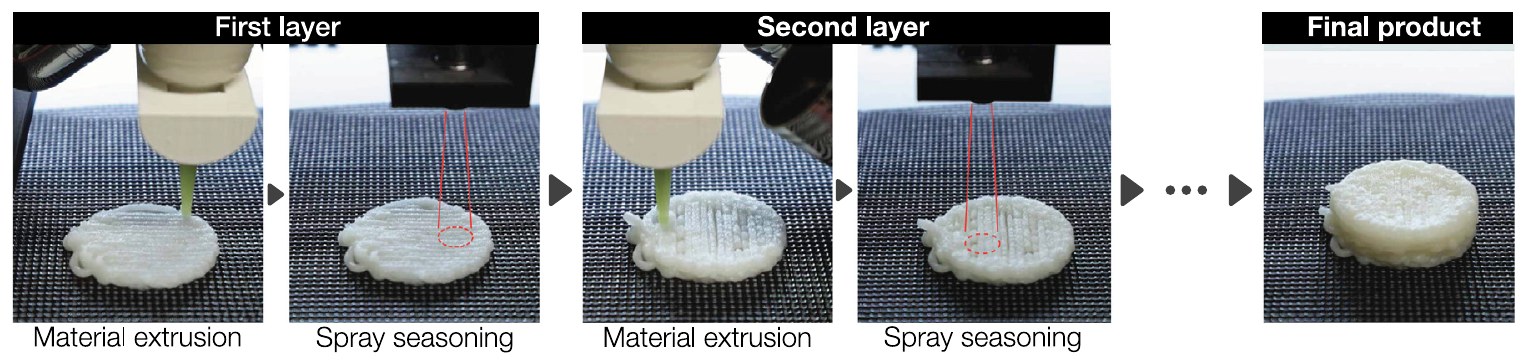
Sequential fabrication: first layer material extrusion then spray seasoning, second layer extrusion then spray seasoning, and so on to the final product.
Fabrication sequence. Each layer is extruded, then the head visits the designated spray positions and fires the selected seasoning channels for their programmed durations. This repeats until the part is complete.

Evaluation

How precisely can a spray place a taste?

We ran two technical experiments (spray resolution and spray amount per shot), a minimal sensory discrimination study, and an exploratory formative user-feedback study with three home cooks.

R² = 0.86
spray-spot size model
R² = 0.99
spray amount vs. duration
27 / 40
trials: centralized pattern judged more localized (67.5%)
~4%
lateral spread on mashed potato after 5 min

1 · Spray resolution

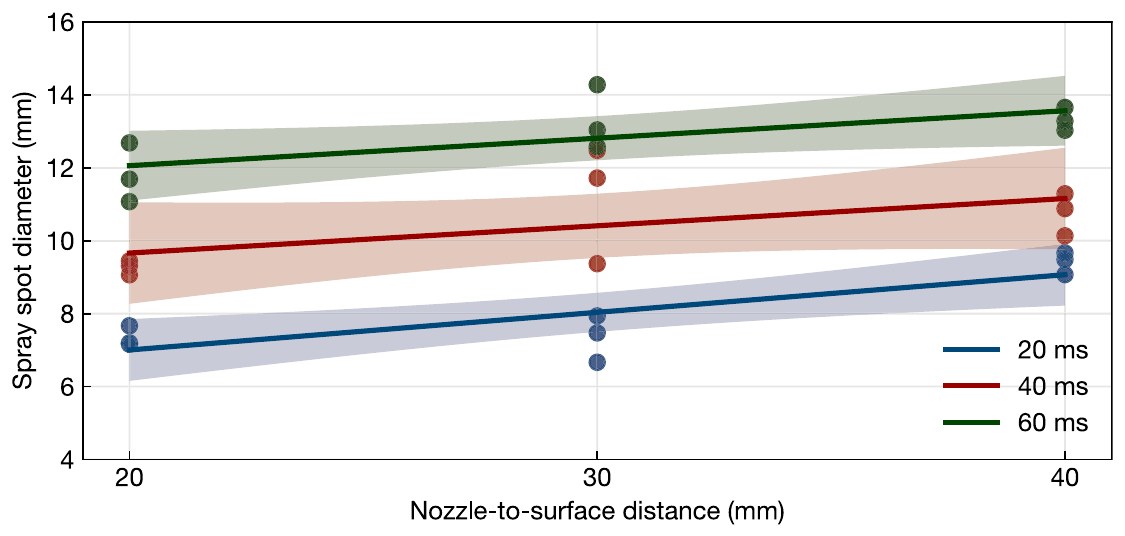
Dyed seasoning was sprayed onto filter paper at 20/30/40 mm nozzle-to-surface distance and 20/40/60 ms duration (0.10 MPa, 3 replicates, n = 27). Spot diameters were measured from rectified top-view images (ArUco markers, Otsu segmentation) and fitted with Size = β₀ + β₁√Distance + β₂√Duration (β₀ = −3.525, β₁ = 1.450, β₂ = 0.918). The mean SD across replicates was 0.79 mm.

Spray spot diameter versus nozzle-to-surface distance for 20, 40 and 60 ms spray durations with fitted lines and 95% confidence bands.
Spray-resolution results. Points are individual measurements, lines are the fitted model per duration, and bands are 95% CIs of the fitted mean.
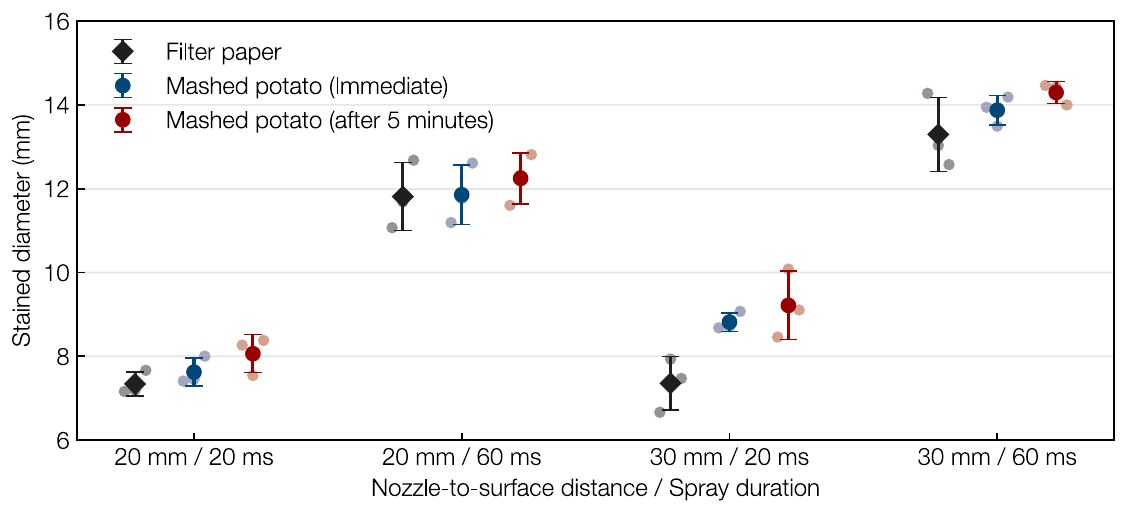
Stained diameters on filter paper and on mashed-potato samples immediately and 5 minutes after spraying, for four conditions.
Edible-substrate check. Filter paper (black) vs. mashed potato immediately (blue) and after 5 min (red). The trend largely transfers to food, with a deviation at 30 mm / 20 ms, so filter paper works for first-pass calibration and final tuning should be done on the food itself.

2 · Spray amount per shot

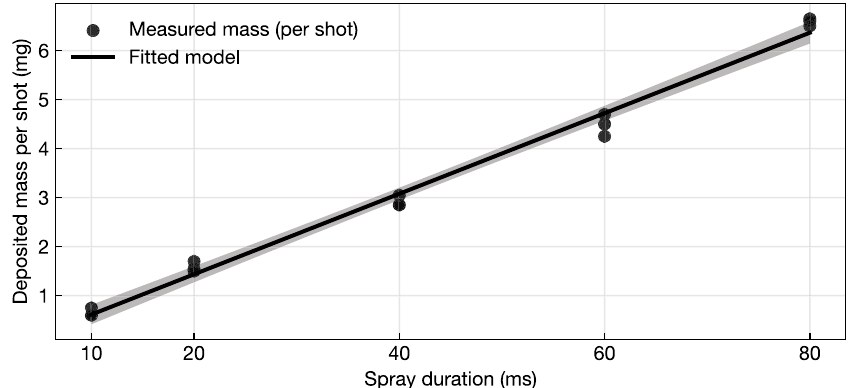
Seasoning was sprayed onto a 0.001 g micro-scale at 20 mm for 10–80 ms (n = 15). Deposited mass grew linearly with duration: Amount (mg) = −0.206 + 0.082 × Duration (ms), with an average SD of 0.2 mg. So the GUI can map a desired seasoning quantity directly to a spray duration.

Deposited mass per shot versus spray duration with a fitted linear model and 95% confidence band.
Spray amount per shot. Points: measurements; line: linear fit; band: 95% CI.

Try it: spray planner

Uses the two fitted models from the paper. They are empirical models of this prototype (filter paper, 0.10 MPa), not general laws.

Tested range: 20–40 mm
Size model tested 20–60 ms; amount model tested 10–80 ms
–
predicted spot diameter
–
predicted mass per shot
30 mm sample (to scale)

3 · Sensory discrimination

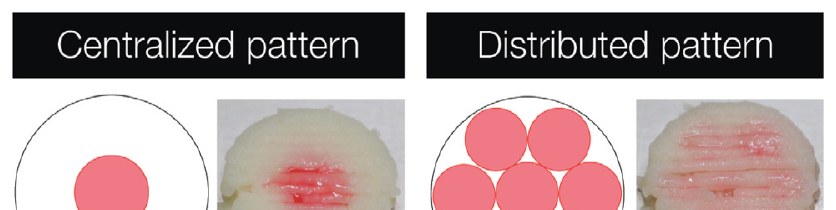
Centralized and distributed seasoning patterns, each shown as a schematic and as a dyed sample.
Seasoning patterns. Centralized (left) vs. distributed (right), each shown as a schematic and a dyed sample for visualization. The actual tasting used clear solutions, so samples looked identical.

Ten participants each did four two-alternative forced-choice trials, comparing samples with identical geometry and nominal salt amount but different spatial distribution. The centralized sample was judged more localized in 27 of 40 trials (67.5%) (chance = 50%). Responses varied between participants. Approved by the IRB (No. R6-E-51).

4 · Exploratory user feedback

Three home cooks with no 3D-food-printing experience each completed a design-and-print session (average ≈ 15 min) and produced foods with spatially varied taste layouts. They found the layer-by-layer cross-section view helpful for reasoning about internal taste placement, saw uses in personalized meals and creative food design, and asked for more taste channels, more realistic food rendering, and a preview of the final taste distribution.

Takeaways

Geometry and taste can be designed separately

1

Duration sets the dose

Deposited mass is linear in spray duration (R² = 0.99), so a target amount of seasoning becomes a spray time.

2

Distance and duration set the footprint

Spot size grows with both. Tune them together for fine or broad taste regions, then confirm on the actual food.

3

Formulation is part of the controller

With upstream valves and open nozzles, liquid viscosity decides whether sprays drip or atomize cleanly; 0.5 wt% xanthan gum worked best here.

Scope & limitations

  • Seasoning is applied after each layer, which makes printing slower than extrusion-only workflows. Six channels limit how complex the taste combinations can be.
  • Validation used a single mashed-potato formulation. Less porous inks (e.g., meat-based) may adhere or diffuse differently, and rheological operating bounds were not quantified.
  • The spot-size model is an empirical calibration for this setup. Lateral spread over longer storage times was not studied.
  • The sensory evidence is a minimal study. Deposited mass is not the same as perceived intensity, and aroma and retronasal flavour are not addressed.
Safety. All food-contact parts were sanitized with detergent and 70% ethanol; syringes and nozzles were single-use; each seasoning had a dedicated reservoir and line. The sensory study was IRB-approved (No. R6-E-51) with informed consent.

BibTeX

Journal article: Applied Food Research
@article{miyatake2026tasteprint,
  title   = {TastePrint: A 3D food printing system for layer-wise taste distribution via airbrushed liquid seasoning},
  author  = {Miyatake, Yamato and Punpongsanon, Parinya},
  journal = {Applied Food Research},
  volume  = {6},
  pages   = {102242},
  year    = {2026},
  doi     = {10.1016/j.afres.2026.102242}
}
Demo: ACM SCF 2026 TBA
@inproceedings{miyatake2026tasteprintdemo,
  title     = {TastePrint: TBA},
  author    = {Miyatake, Yamato and Punpongsanon, Parinya},
  booktitle = {Proceedings of the ACM Symposium on Computational Fabrication (SCF '26)},
  year      = {2026},
  publisher = {ACM},
  doi       = {TBA}
}

Acknowledgments

This work was supported by JST ACT-X Grant Number JPMJAX24CQ and JSPS KAKENHI Grant Number 23K11198, Japan.