Odor depends on trigger distance
2.33 at 4 m
Against 3.36 at 2 m and 3.24 at 3 m. F(1.84, 18.40) = 9.53, p = .002, ηp2 = .488. 2 m and 3 m do not differ (p = 1.000). Speed had no effect on odor.
International Conference on Extended Reality (ICXR) 2026
Saitama University, Japan
Olfactory presentation has been used to enhance immersion in virtual environments (VEs). Traditionally, odor stimuli are delivered either by attaching an odor-emitting device directly to a headset or by installing a fixed device on the ground. However, these methods can reduce immersion because of added physical burden or limited spatial flexibility when the user moves. We propose a drone-based olfactory presentation system in which an odor-emitting module is mounted on a small flying drone. Our approach removes the need for wearable hardware while enabling spatially adaptive odor delivery, overcoming the limitations of both wearable and fixed olfactory display systems. We investigated how the drone can synchronize with the user’s movement so that odor is delivered before the user reaches the target position, just as the drone begins to depart. Across a 3 × 3 grid of withdrawal trigger distances and withdrawal speeds, perceived odor intensity varied with the trigger distance, while perceived airflow varied with the withdrawal speed. Applying an explicit selection criterion, i.e., maximize perceived odor, minimize perceived airflow, prefer greater user clearance, the sampled conditions favor initiating withdrawal at 2–3 m and retreating at approximately 40 cm/s. Based on these findings, we derive design implications for drone-based olfactory presentation.
Section 3
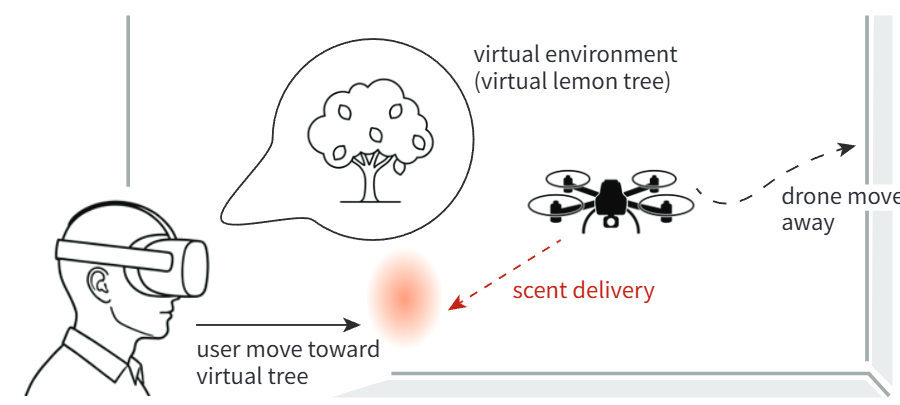
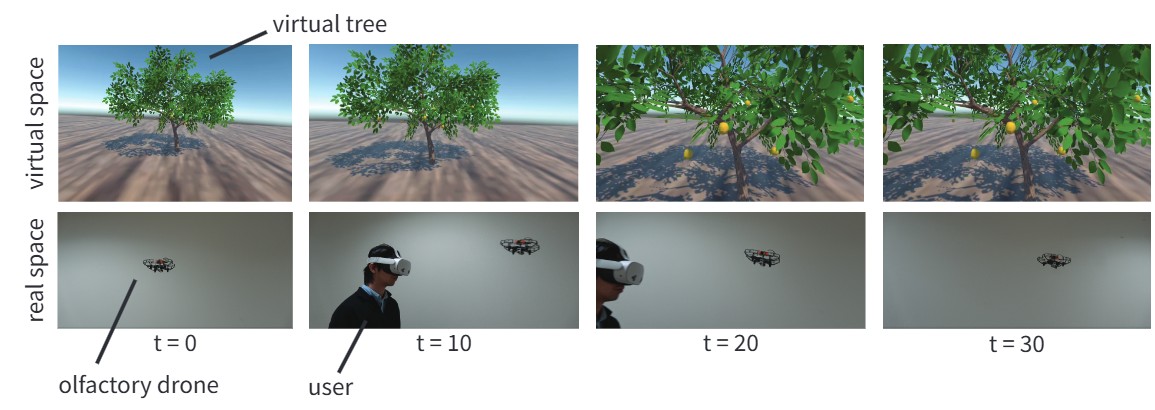
A worn display presses hardware against the face. A fixed display stays put while the user walks around. OlfaDrone puts the odor source on a small quadrotor that is mapped to an object in the virtual scene. When the user walks toward the virtual lemon tree, the drone hovers there and releases scent. As the user gets close, it moves away, so the smell is still there when they arrive but the propeller wind is not.
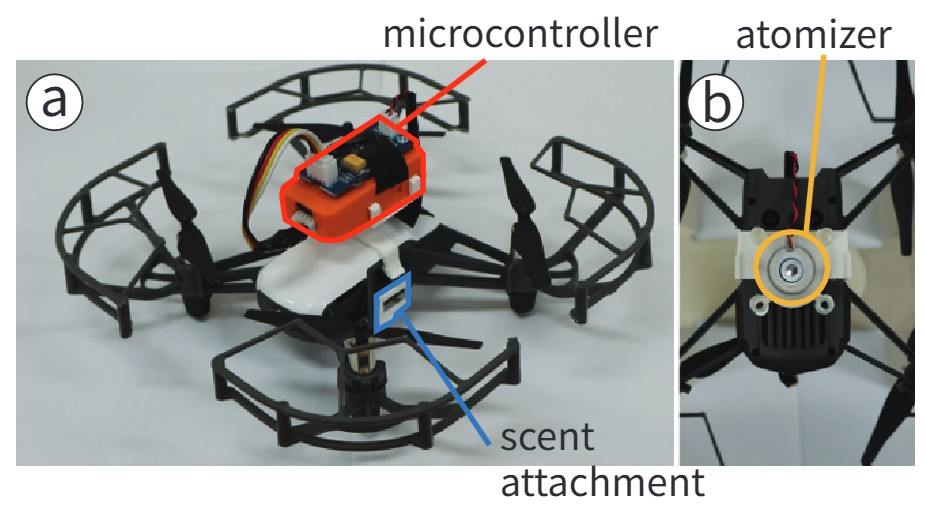
An atomizer was chosen over an air pump because it spreads odor wider and faster. That matters when the drone’s own downwash is pushing air around.
Experiment 1 · 11 participants · within-subject 3 × 3
The drone hovers at the tree and emits citrus scent for about 10 s. When the walking participant reaches the withdrawal trigger distance (2, 3 or 4 m), the drone retreats at a set withdrawal speed (20, 40 or 60 cm/s). Participants rated odor intensity and wind sensation on 7-point scales, with at least 15 min of airing out between trials.
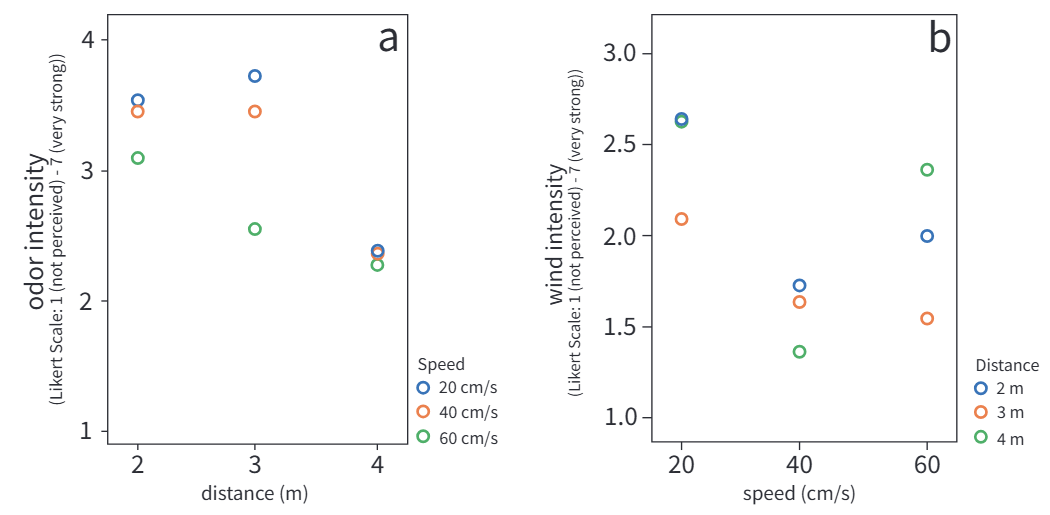
Estimated marginal means (1 = not perceived, 7 = very strong). Hover over or tap a cell to compare both percepts. Outlined cells are the recommended operating region. That choice follows from the two significant main effects, not from differences between individual cells, which the data do not resolve.
Odor depends on trigger distance
2.33 at 4 m
Against 3.36 at 2 m and 3.24 at 3 m. F(1.84, 18.40) = 9.53, p = .002, ηp2 = .488. 2 m and 3 m do not differ (p = 1.000). Speed had no effect on odor.
Wind depends on withdrawal speed
−0.88 40 vs 20 cm/s
F(2, 20) = 7.15, p = .005, ηp2 = .417. Counterintuitively, the slowest retreat felt windiest: the user keeps closing on the drone and stays longer under its wake. Trigger distance had no effect on wind.
| Distance (m) | Speed (cm/s) | Odor mean (SE) | Odor 95% CI | Wind mean (SE) | Wind 95% CI |
|---|---|---|---|---|---|
| 2 | 20 | 3.545 (0.366) | [2.730, 4.361] | 2.636 (0.432) | [1.673, 3.599] |
| 2 | 40 | 3.091 (0.436) | [2.119, 4.062] | 1.727 (0.273) | [1.120, 2.335] |
| 2 | 60 | 3.455 (0.390) | [2.586, 4.323] | 2.000 (0.381) | [1.150, 2.850] |
| 3 | 20 | 3.727 (0.384) | [2.873, 4.582] | 2.636 (0.453) | [1.628, 3.645] |
| 3 | 40 | 2.545 (0.340) | [1.788, 3.303] | 1.364 (0.203) | [0.911, 1.817] |
| 3 | 60 | 3.455 (0.366) | [2.639, 4.270] | 2.364 (0.432) | [1.401, 3.327] |
| 4 | 20 | 2.364 (0.388) | [1.499, 3.228] | 2.091 (0.343) | [1.328, 2.854] |
| 4 | 40 | 2.273 (0.384) | [1.418, 3.127] | 1.636 (0.338) | [0.884, 2.389] |
| 4 | 60 | 2.364 (0.411) | [1.449, 3.279] | 1.545 (0.207) | [1.084, 2.007] |
Experiment 2 · 10 participants · drone hovering in place
The drone hovered at the tree while emitting odor, turned to face the user at 0°, 45° or 90°. Participants walked toward it at a slow, steady pace and stopped as soon as they first smelled citrus. We recorded how far that stopping point was from the drone.
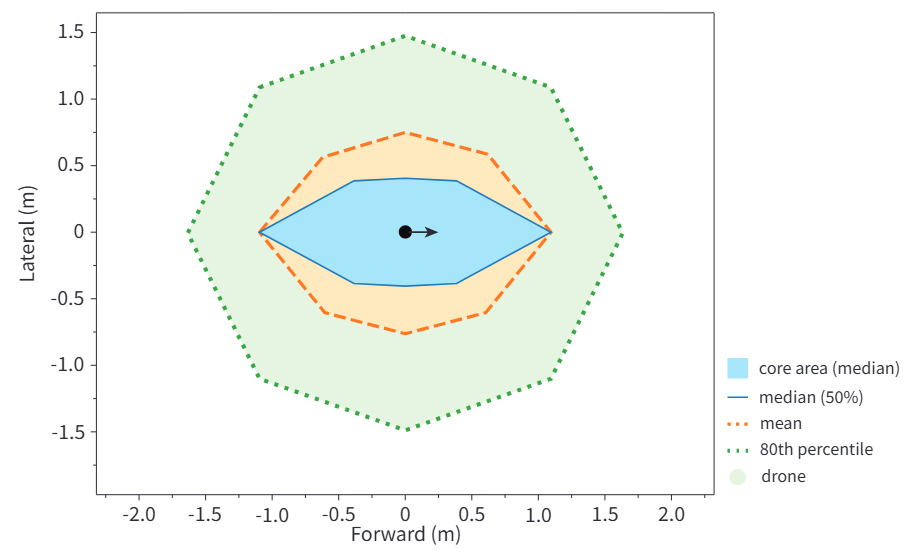
Orientation had no significant effect (F(2, 18) = 0.46, p = .639). The intervals overlap almost completely, so this shows no evidence for an effect, not evidence that there is none. Medians were about 0.8–1.1 m, so plan on the low end of that range for delivery you can rely on.
Design implications
Withdrawing at 4 m clearly weakens the odor, while 2 m and 3 m are equivalent. Trigger distance and exposure time vary together here, so think of it as when the drone leaves, not just how far away it is.
Withdrawal speed drives the wind sensation, and trigger distance drives odor intensity. Because the two cues respond to different parameters, they can be tuned independently.
The slowest retreat produced the strongest wind. An intermediate speed gives less wind at no cost in odor.
Start withdrawal at
2–3 m
Retreat at
≈ 40 cm/s
Criterion: maximize perceived odor, minimize perceived airflow, and where the data can’t tell two settings apart, prefer the one with more clearance between drone and user.
Safety: flight was restricted to a predefined volume, propeller guards were fitted, and participants could stop at any time. The study was approved by the Saitama University Research Ethics Committee. No collisions or aborted trials occurred.
@inproceedings{unoki2026olfadrone,
  title     = {OlfaDrone: Characterizing Odor and Airflow Perception
               in a Drone-Based Olfactory Display for XR},
  author    = {Unoki, Ryosei and Hatsakornkhanachok, Natthaphon
               and Punpongsanon, Parinya},
  booktitle = {International Conference on Extended Reality (ICXR)},
  year      = {2026}
}
Acknowledgments: this work was partially supported by JSPS Fellows Grant Number 16J00049 and JST BOOST Grant Number JPMJBY25E2.